
Marketing Case: Olay
How did a US$2 billion brand get cut in half?
ClassMon, Oct 12 09:00–10:30 (Boston time) · Market-Facing Functions · Das Narayandas
Contents4 sections
Unit 3 has begun, with Professor Das Narayandas's Market-Facing Functions, and the first case is Olay: Facelift at Olay (A).
This is not a story of "an old brand beaten by new brands." It is the story of a brand that took itself apart.
I wrote this before class. I'm putting my judgement down here first, and I'll come back to compare after class.
Here goes — enjoy:
Case Summary
On October 4, 2017, Chris Heiert, general manager of P&G's North America skin care, received an email from senior leadership: Olay's July–September sales were down 12% year on year — a big miss even against already low expectations. Does the full-year growth you promised still stand?
Where Olay came from: born in South Africa in 1952 as a bottle of pink "beauty fluid." It came into P&G with Richardson-Vicks in 1985, when it had just 5 SKUs and annual sales of US$165 million.
The golden decade (2000–2009): - In 2000 it dropped "Oil of" and became Olay; it launched Total Effects at US$19.99, "fighting the seven signs of aging," positioned as "the efficacy of Lancôme and Estée Lauder at half the price." - In 2003 it launched Regenerist, with pentapeptides, "without surgery." After a dermatologist endorsed it on morning TV, shelves were cleared out. - In 2007 it launched the "red jar," Regenerist Micro-Sculpting Cream. - P&G called this playbook masstige (mass + prestige): department-store efficacy, sold at Walmart. In 2008 Olay held 16.7% of US facial care, and in 2009 its global retail sales passed US$2 billion.
The decline (2010–2017): - Five sub-brands sat on the shelf at once, up to 140 SKUs at Walmart alone, with overlapping efficacy claims. Consumers saw an ad, came into the store, couldn't remember which jar it was, and walked out empty-handed. - 30–40 new products launched every year. In one retailer's words: "Olay hasn't delivered on its promises; we no longer count on it to drive category growth." - In 2013, to win over college students, it launched the Fresh Effects acne line. First-year sales: US$8 million. - Between 2008 and 2015 it went through three general managers, each with their own strategy. - Millennials called it "Oil of Old Lady." - In fiscal 2017, retail sales fell back to just over US$1 billion. Cut in half.
The world outside: the market itself was growing — US skin care was worth US$17.7 billion, growing 6.7% a year; China, US$26.9 billion, growing 8.7%. The growth went to others: Glossier through Instagram and "unboxing"; Rodan + Fields through dermatologists plus social-media direct selling, passing US$1 billion in sales in 2017 and overtaking Olay; K-beauty got into Walmart with sheet masks, serums and the "10-step routine." Meanwhile, 80% of Olay's advertising budget was still on TV, and less than 5% on digital.
What was still in hand: 90% awareness among US adults. The red jar was the category's best-seller; Good Housekeeping testing showed it beating creams costing four times as much, and it was rated 4.5–4.7 stars online. Skin-care gross margins were healthy. But the red jar's household penetration was just 2%.
Heiert's three choices: 1. Sell or not? In 2015 P&G had just sold 43 beauty brands to Coty. 2. Focus on 35-plus, or chase 21–35? 3. Expand the product line, even go all in on DTC — or cut SKUs?
My Thinking
Don't sell — selling cures headquarters' impatience, not the brand's problem
Selling means dumping a still-living asset at its lowest point.
90% awareness, the category's best-seller, reviews of 4.5 stars and up, healthy margins, a category that is still growing — this is not a brand to be liquidated. What P&G sold in 2015 was CoverGirl and Clairol; what it kept was Pantene, Head & Shoulders, Olay and SK-II. Olay sits in the pillar tier.
Selling cures headquarters' impatience, not the brand's problem.
The money is over 35; "young people drive growth" is the retailers' anxiety
Let the data speak first. US skin-care sales in 2017: 55-plus accounted for 40%, 45–54 for 24%, 35–44 for 20%, and under-35s only 16% — and those shares barely moved in three years.
"Young people drive growth" describes the growth rates of new brands and the anxiety of retailers, not where the sales are.
The tier Olay once won was US$17–25, which is 35% of the category. The price band wasn't wrong; what was wrong was that the products within it were impossible to tell apart.
And Olay has already run the "win over young people" experiment once — Fresh Effects, US$8 million, which also muddied "what Olay actually is" even further. Young women's entry product is makeup-removing wipes, which is Neutrogena's turf; natural ingredients belong to Aveeno; conversational feel belongs to Glossier.
One brand cannot say "I understand you best" to a 19-year-old's acne and a 55-year-old's wrinkles at the same time.
140 SKUs are both the result and the cause of decline
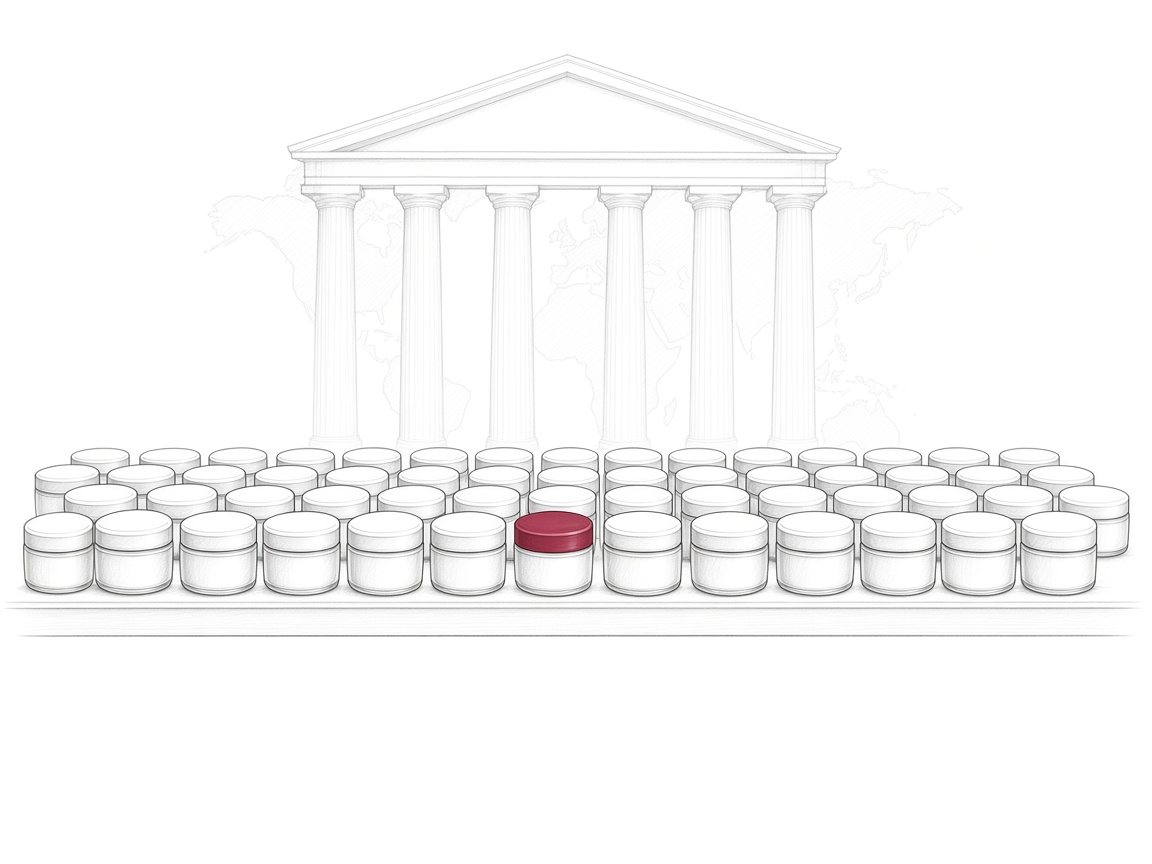
140 SKUs and 5 sub-brands are both the result and the cause of Olay's decline.
With 30–40 new products a year, retailers had already stopped believing. Adding yet another line now, or charging into e-commerce precisely because "we have no DTC experience," would spread already thin resources even thinner.
The red jar's household penetration is only 2%. There is far more room in selling this one jar clearly than in building yet another sub-brand.
Olay wins by becoming clear, not by becoming young
Look back at Olay in 2000–2009 and the formula was actually simple: one promise (visibly younger), one price logic (premium within mass channels), and a few hero products with real science behind them.
The decline was Olay dismantling that formula itself. Five sub-brands fighting over the same line, "innovation" reduced to launch speed, three general managers with three strategies.
The brand's meaning shrank to the two lines from internal interviews:
"Olay is a warm wool scarf. You need it, but it isn't fashionable." "If Olay were in a high school and the popular girls ranked 1 through 8, she'd be number 9. Close to popular, but not in that circle."
The word "anti-aging" went out of date before the products did
In 2016 Olay surveyed 6,800 women in 11 countries: two-thirds felt that age no longer mattered as much as it had for their mothers' generation, and 80% believed it would matter even less in future.
Olay's science isn't outdated; Olay's language is.
So the answer isn't "go back to the 2009 slogan," but to go back to the structure that actually worked back then — few products, clear, proven efficacy, numbers that add up for retailers — and then say it differently: move from "fighting aging" to the line the team had already hit upon, "skin that looks young, so it doesn't give away your age."
Olay didn't lack strategy; it had too many strategies in seven years
The course description has this line: "No good strategy can succeed without excellent execution."
Olay's problem was precisely not a lack of strategy, but too many strategies over seven years.
The four hardest things in execution: - Retailers won't give you shelf space back just because you promise to simplify. If you cut SKUs yourself, they'll give the freed-up space to Neutrogena, K-beauty, Drunk Elephant. So this isn't pleading — it's a trade: voluntarily give up dead stock, on condition that the hero products' facings are written into the next planogram. Walmart accounts for US$10 billion of P&G's sales; this negotiation is the strategy itself. - In the quarter you cut items, the numbers will look worse first. Be honest in replying to that email — this quarter's growth won't be won back by launching more products. Swap the growth promise for a path with dates on it. - Lost customers are hard to win back. As Heiert herself said: the brand gave her a reason to leave, she left, and she discovered another brand. The awareness is still there; the habit isn't. - The incentive system works against the strategy. If the front line is still measured on "how many SKUs we launched," they'll read "cut the product line" as "give up on growth." Strategy and metrics have to change together — stop the launch quotas and look at only four numbers: red-jar sell-through, repeat purchase, retailer gross margin per foot, and household penetration.
One more thing: from headquarters, first get one commitment — no change of strategy and no change of general manager for 24 months. The failure pattern of the past seven years was a change every year.
Takeaways for Arcus42
Reading about Olay, I kept thinking about us.
The easiest mistake for a multi-family office is exactly Olay's: wanting to do everything, saying "we have that too" to everything, so that clients stand in front of the "shelf" unable to tell what you actually are — and leave empty-handed.
First, answer "who are we for" before answering "what do we do." 35-plus or 21–35 is not a market-segmentation question; it's a question of "whom are we willing to give up." A family office is no different — being willing to serve everyone means serving no one.
Second, there can be only one hero product. What the red jar is to Olay is our one core deliverable that "shows visible results and adds up financially." Everything else is a bridge. Bridges can stay, but budget, people and attention go first to the end that has already been proven to work.
Third, the entropy of trust starts with 30–40 "new products" a year. When retailers said "you haven't delivered on your promises," Olay still thought it was innovating. Every promise you can't keep quietly lowers the odds of being believed next time. With family clients, this is a debt we can even less afford to run up.
Fourth, language goes out of date before products do. Olay's science was fine; the word "anti-aging" was what went stale. Of the words we say to families — "succession," "structure," "allocation" — which are still being heard, and which have already become background noise? I don't have an answer to this, but it's worth asking once a year.
Fifth, strategy and metrics have to change together, or strategy is just a PowerPoint deck. All three general managers had strategies. What never changed was the metric "new launches = growth." An organisation does what it is measured on, not what it is told.
Final Words
Before class, I cast my vote for "few and clear."
After class, I'll look at which of these got overturned, and by what.